Science's Humanities Gap
I decided to go with another article this week. This time it's because I'm obsessed with my NY Times subscription. But anyway..
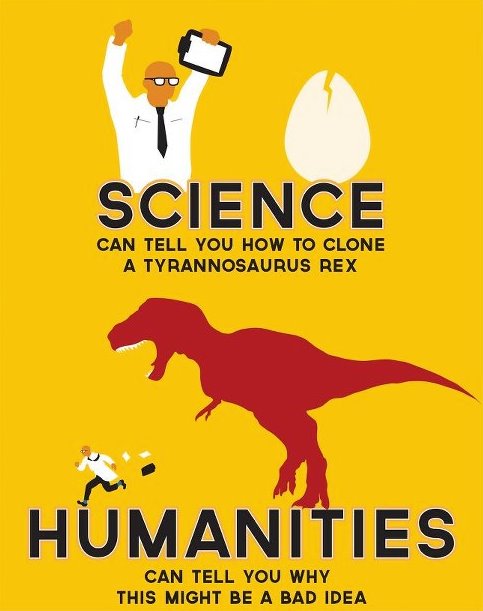
I was browsing around and I came across this article "Science's Humanities Gap" by Gary Gutting, a professor of philosophy at the University of Notre Dame. Click here to read the full article- I highly suggest reading it! In the article, Gutting responds to recent claims psychologist Steven Pinker has made regarding humanists in his sermon "Science is Not Your Enemy." Pinker pleas for humanists to pay more attention to science. This request, undeniably, is important, but what Gutting maintains throughout this article is that humanists are the ones practiced in sciences and scientists are the ones who should study more humanities.
While reading this article, I was thinking back to the bio-psycho-social approach to psychology, and how it is important at looking at something from all angles in order to come to an informed conclusion.
In his article, Gutting notes that philosophers of mind who work in cognitive science are typically trained in that discipline. On the flip side, however, there are very few cognitive scientists and neurosciences that have a comparably strong background in philosophy of mind. What do you all think- is it important to be well-versed in both philosophy/humanities and science in order to be a successful cognitive scientist or neuroscientist? Gutting brings up a very interesting conundrum that pops up often for cognitive scientists: how do scientists interpret the bearing of their results on philosophical issues such as free will and happiness without being better versed in humanities?
Gutting brings examples from all different forms of science and humanities: epistemology empirical psychology, philosophy of physics and biology to name a few. There is now an evolutionary and neurological study of literature. Historians of science are often immersed in the areas of science they study, but few scientists do serious work in the histories of their discipline. Is this necessary? How much is gained by thinking seriously about the history of one's discipline? Would focusing more time on it be more enlightening, or be a waste of time?
Here's a quote I liked, "The problem of disciplinary narrowness became critical only with the advent of "scientists"- a term invented in the 19th century- whose work became so technical that it was hard to avoid the perils of overspecialization" (Gutting). Some questions about ethics and the welfare of humans cannot be answered by science alone. Where is the gap? What do you think? Comment below!


This is very interesting. I've thought about this topic before, actually, and each time I have more and more questions. Really, it would make sense if both groups knew a sufficient amount about each other to know best how to conduct their work; scientists should also have a humanistic background. This would directly effect all those ethics arguments that come up. Realistically, however, this would be hard to do.
ReplyDeleteRachel, I found your blog post quite interesting. I think the answer to your first question is collaboration. For example, my father works at St. Jude. He studies cancer in the pons known as a high-grade brainstem glioma. He works purely with the biological aspects of this disease while psychologists working at St. Jude handle the cognitive and historical/humanities ramifications of his findings. (I know this is not exactly what you were referring to.) Outside of a research hospital setting, I think that a psychologist of any kind should be knowledgable, on at least an intermediate level, about most all aspects of their field. Yes, there should be collaboration between professionals with different specialties and among different subdivisions of psychology in one professional's repertoire.
ReplyDelete