Classical Conditioning is learning to associate two stimuli and to anticipate an event.
Recently I got a dog. We have been trying to train her to go to the bathroom outside, because she would always go to the bathroom on the carpet, and I would have to clean it up, which I hated. First we started trying to crate train meaning that she would be in her crate all day and then when we came home from school/work, we would take her out and she could take care of her business outside. It was working for a while, but then we stopped crate training her and she was taking care of her business inside again. Then we had to go back to crate training and we would give her treats every time she would come back from her walk after going to the bathroom outside, but then she started to get fat. Nothing was working, but that's probably just because we hadn't been training her long enough.
Anyways, reason for me telling you this: As we were training her to go to the bathroom outside, my mom told me a story about her friend and how her friend trained her dog in a classical conditioning type of way . What m mom's friend did was that every time they would take the dog out for a walk and to go to the bathroom, they would take the dog's paw and tap it on a bell that was hanging on the door, which would make the noise. After a while the dog had learned to associate the bell and going to the bathroom. The dog learned to tap the bell when it needed to go outside to go to the bathroom.
When my mom told me about the dog, we had not learned about classical conditioning yet, so I just thought that it was a cool idea that the dog was able to do that after a while. After learning about classical conditioning, I actually understand what was going on with the dog while it was learning to go to the bathroom outside. Maybe we should try that on my dog and maybe she will stop going to the bathroom on all of our carpets.
While conducting research on classical conditioning at the University of Pennsylvania in the 60's, Martin Seligman accidentally discovered the theory of learned helplessness. He observed that dogs that received a shock on one side of a box didn't even try to jump over the dividing fence to the other side of the box where, unbeknown to the poor pup, there would be no shock given. The dog here illustrated the concept of learned helplessness- he didn't even attempt to escape to safety because he assumed the shock would be on the other side of the fence as well. This assumption is an example of the cognitive element of classical conditioning.
Learned helplessness is very much present in humans too. In life we are constantly faced with failures and defeats that crush us. They make us feel like we are helpless, that we have no control over our lives and what goes on in it. Learned helplessness explains why we often remain passive or indifferent to adverse situations in life even when we have the capability of changing the outcome. The idea of earned helplessness has even been used in relation to very weighty situations and disorders such as depression, domestic abuse, poverty, discrimination, addiction, etc.
The moral of the story: We have control over our lives and situations. Want to lose those few extra pounds? Hard work will get you there! Want to improve your grades? Better get on it, sister! Want to make some extra moolah? Find someone in need of a babysitter! You got this, I promise.
(Am I as inspiring as Charlie Harary yet?)
I'll end here with a fun fact: Martin Seligman's favorite color is magenta because of its amazing calming effects on then body. Cool.
Generalization: when the same response occurs for similar stimuli. Discrimination: learning to respond differently to different stimuli.
These two things are so fascinating. They're opposites of one another, yet they both happen rather frequently.
Let's look at some examples of the two things..
Generalization: when a child learns how to say dog when he sees a specific type of dog (ex. a poodle) and then he says dog again when he sees a different type of dog (ex. a german shepherd) the child has generalized between the two stimuli.
Discrimination: going back to the example of Pavlov's dogs - if the dog had salivated only at the sound of the tone that had been paired with the food and not a similar tone that was slightly different it would have been discriminating.
What I want to know is how does one thing happen over another??
I think that a lot of it has to do with the stimulus and also the persons mindset at the time. It just goes to show you that classical conditioning is just another one of those things we can use the bio-pscho-social approach for!
There are biological influences (genetic predispositions, unconditioned responses, adaptive responses), psychological influences (previous experiences, predictability of associations, generalization, discrimination), and social-cultural influences (culturally learned preferences and motivating, affected by presence of others).
A test was done on children. They wanted to see how much patience and understanding kids have. They sad a kid in a room with one marshmallow. They told them that if they don't eat the marshmallow the whole time they have to wait then they get another one. The results where interesting. Some kids ate it right away. Some waited but then couldn't resist. A few withstood the challenge and kept out until they received the second one. They realized that by suffering now they will get a larger reward later.
How much to we understand and learn about time. Do we learn and understand how we should act today to benefit tomorrow? What age do we learn that concept. I wonder if those kids turn out differently when they are older. Are the patient kids more successful? Do they do better at school? The way we learn is a fascinating subject. But how much do personality play into it all?
While we were learning about operant conditioning in class, we learned all about reinforcement and punishment. We also learned about how positive and negative mean adding something and taking something away, respectively. As we were going through all of the concepts and related examples in class, all I could think of was parenting. How do our parents use reinforcements and punishments to get their children to behave the way they want them to behave? Then, on Saturday night, I was sitting in my room, when "What Would You Do?" came on. Funny enough, the episode was about parents who put their kids on leashes. Here's the video:
Naturally, as they said at the start of the video, this video was a representation of the leash concept's extreme conclusion. I would like to examine the concept of putting a child, or even a dog, on a leash. First of all, using a least is a form of positive punishment. It adds the leash to help get rid of the negative behavior: running away. Yes, I understand that this is not always the case. Sometimes, leashes are merely used as safety measures to keep dogs and children close by.
Imagine that your two-year-old kid loves running away from you in the middle of the grocery store. As a parent, you have a few options. For example, you can either take the kid outside when he runs away (negative punishment) or you can put a leash on the kid to keep him from running too far (positive punishment and safety). Recently, I have noticed that many parents are opting for the leash method, especially for toddlers and energetic children. Interestingly enough, a lot of parents actually think that putting their kids on leashes isn't a form of punishment at all. I suppose it depends on the situation. Even so, leashes have gotten a bad rap recently because some parents, like the "mom" in the video, treat their children like actual animals.
Here are some questions to consider: What would you have done if you saw the child in the video tied to the post? As a future parent, will you even consider using this form of positive punishment on your children? Do you think it actually works?
This past May, I took a family vacation to California, and oh boy, do I miss it. Anyways, when we were at Sea World in San Diego, the last show that we say of a seal/sea lion show. Even if you have been to the Memphis Zoo, you have probably seen seal and sea lions perform right?
It was a hot day, and my family and I were getting tired. We decided to see one last show before heading out. Oh man, did we choose wisely. As we sat down and were waiting for the show to start, I looked at the stage and saw the trainers practicing with the seals and sea lions. Every time they had done a trick correctly they got a fish. At the time, I really didn't think anything of it at the time. Of course they would give them fish, because in their wild habitat, that is what they would eat anyways. So basically, I thought of it as a simple snack.
This past week in class we had started the unit on learning. There are three types of learning, but I want to focus on one particular one, called operant conditioning. Operant conditioning can be described as when an organism's behavior is reinforced by its consequence. Now the fish for a trick thing made sense. I can now understand that the trainers were giving the seals and sea lions fish as positive reinforcement. The fish, being the positive reinforcement, made the seals and sea lions think that, "oh, maybe if I do that trick again, I'll get another fish!" Because of this amazing concept of operant conditioning, Seamore, the sea lion can entertain America!
Besides, positive reinforcement, there is also something called positive punishment. Now, I know what you might be thinking, how can punishment be positive. We must not think of punishment as a bad thing because in psychological terms all it means is doing an action to make a behavior stop. For example, when my dog was puppy and was not house trained, he used to pee all over the house. When he did so, we called him over to the puddle and stuck his nose in the pee. I mean, I don't think pee smells so good, so between that and taking him outside to pee as often as possible he learned not to pee in the house. So, let me break it down. Leo peed in the house (the behavior that we didn't like), we took his nose and stuck it in the pee (positive punishment because it was adding something to make the action stop), and he eventually stopped peeing in the house (desired response). Leo is just so smart! (I love funny memes)
As we continue to learn about learning, I find it more and more interesting. This week we focused more on operant conditioning, the second idea? method? of learning. Operant conditioning is where we learn to associate our behavior with the consequences of this behavior and thus to repeat acts followed by good results and to avoid acts followed by bad results. Pretty much, operant conditioning revolves around reinforcements (rewards) and punishments (punishments).
Unlike classical conditioning, which upholds the beliefs of Pavlov and John Watson, operant conditioning revolves around the ideas of Thorndike and Skinner. Thorndike believed in the law of effect, which states that something that is reinforced will continue to be performed in the future, and vice versa. Skinner developed the operant chamber (or the Skinner box) that revealed principles of behavior control. In this box, there would be different things for testing behavior, such as lights, bars, food and water dispensers, etc. Through this box, Skinner wanted to see if a rat could learn to push the bar when being reinforced with water or only when the light comes on.
These ideas contained the principles of shaping and reinforcement/punishment. In shaping, reinforcers are any events that strengthens a preceding response. There is also successive approximations, or chaining, where the animal would be reinforced first for going near the bar, then touching the bar, and then eventually pressing the bar- you are using successive approximations and reinforcement to get the animal to produce the desired behavior.
The discriminative stimulus is also part of these ideas. The animal learns to discriminate from the desired product. For instance, if a rat was conditioned to only press the bar when a square came up, it would discriminate any other shape.
Reinforcements and punishments are the basis of operant conditioning. It is important to remember the the psychological definitions of reinforcement and punishment differ from the normal definition. In psychology, reinforcement is any event that strengthens a preceding response and increases the likelihood that it will occur again in the future. Punishment is any event that diminishes a preceding response and decreases the likelihood that the behavior will occur again in the future.
Another part of reinforcements and punishments that aren't how we usually think are positive and negative reinforcements and punishments. Positive reinforcements is where something added to make the behavior continue and positive punishments is where something is added to make the behavior stop. Negative reinforcements is where something is taken away to make the behavior continue and negative punishments is where something is taken away to make the behavior stop.
On psychologytoday.com, there is an article entitled "Should You Punish Your Child" that clearly applies these ideas. According to Gina Green, the best way to reduce undesired behavior is to provide reinforcement for good behavior. Instead of using punishments, which often lead to resentment, emotional strife, or avoidance, use positive reinforcement! By looking at the situation in a different light, there's a better chance that you'll get the desired behavior.
The article refers to "source amnesia". In the comic, Calvin is pretending to have actual amnesia. The point is: I love Calvin.
The New York Times posted an article written by Sam Wang and Sandra Aamodt on June 29, 2008 entitled "Your brain lies to you". READ IT. CLICK HERE. YOU'LL LOVE IT. I know it's not a TEDx video, but it's still worth something in my eyes.
False beliefs; this is the premise of the article. This article was written, remember, back in the summer of 2008, when current President Barack Obama was still a just a senator on a campaign. And on this groundbreaking campaign of his, he was faced with many an obstacle. One such obstacle was the accusation that he was a "Muslim". Now, I know. It sounds dumb to discriminate against someone because he/she is a Muslim. But, you know... Discrimination is odd and fears are irrational. Anyways, the point is that 10 percent of the citizens in this country believed Obama to be a Muslim even though he's Christian. How is this possible? Well, the brain is a weird and complex thing. (It's not as weird and complex as Americans, but it's cutting it close.. ;) )
The article goes on to describe how brain stores information. Facts are stored in the hippocampus, but every time we recall information, our brain writes it down again. It is reprocessed. In time, the fact is gathered in the cerebral cortex and is separated from the context in which it was originally learned. Do you remember how you learned every fact you know? Do you think you could trace all your known-facts back to their sources? This phenomenon is known as source amnesia; because of this, people might be lead to forget whether a statement is true or false- even when a lie is presented with a disclaimer.
Misremembering gets worse over time. "A false statement from a non-credible source that is at first not believed can gain credibility during the months it takes to reprocess memories from short-term hippocampal storage to longer-term cortical storage." Have you ever found yourself believing something to be true when you knew the source wasn't credible? Campaign strategists use source amnesia to spread misinformation. Over time, when repeating a falsehood, people may back it up with "I think I read it somewhere" or something like that. The more you're exposed to a falsehood, the more likely you are to believe it and give it credibility. The article then quotes the Stanford study with the students who either opposed or favored capital punishment. Hey! That was in the book! Fun! But in the book it focused on how we like to believe things that favor our opinions. Indeed, so does the article- "ideas can spread by emotional selection, rather than by their factual merits, encouraging the persistence of falsehoods." Are you quicker to believe ideas that you agree with? Be honest!
Things to think about:
What does it take to get people to listen to ideas outside their personal beliefs?
During last night's whirlwind of a storm, I browsed through the handy-dandy interweb, looking for "blogspiration."Suddenly, as the rain pattered against my window, I stumbled across a perfect example of operant conditioning. The laugh-inducing video, from an episode of The Big Bang Theory, describes how Sheldon Cooper attempts to modify Penny's behaviors using operant conditioning.
First, let's define operant conditioning. Operant conditioning is learning to associate a behavior (a response) with the consequences of this behavior and thus to repeat acts followed by good results and to avoid acts followed by bad results. Organisms associate their own actions with consequences. Learning takes place after the response and is used to impact future behavior.
Operant conditioning is based off the ideas of Edward L. Thorndike and B.F. Skinner. Thorndike introduced his law of effect which is the basis of operant conditioning. His idea was the principle that behaviors followed by favorable consequences become more likely and that behaviors followed by unfavorable consequences become less likely. Skinner developed a behavioral technology that revealed principles of behavior control. Skinner designed an operant chamber, otherwise known as a Skinner box, containing a bar or key that an animal can manipulate to obtain a food or water reinforcer. Attached devices record the animal’s rate of bar pressing or key pecking. To form behavior, Skinner used shaping, a procedure in which reinforcers guide behavior toward closer and closer approximations of the desired behavior.
The first part of the four-minute, twenty-two second clip, is of Penny doing behaviors that are favorable in Sheldon's eyes. She clears his plate, assures he has a seat on the couch, remains quiet, and takes her phone call outside. Each time she does so, she receives a chocolate. Sheldon was using positive reinforcement to strengthen Penny's response. Sheldon added a desirable stimulus, the chocolate, following the correct behavior so that it would continue.
Leonard realizes this, and is soon offered a chocolate for his correct assumption. He declines, but Sheldon assures him that he can train Penny to jump out of the pool bouncing a beach ball on her head (that had me laughing). When Leonard forbids Sheldon from applying the principles of operant conditioning on Penny, Sheldon sprays Leonard with water, therefore using positive punishment to stop the behavior. He administered an aversive stimulus to cease the behavior or response from occurring again.
Sheldon then tells Leonard that if he were to use negative reinforcement, he could train Penny by the time they were ready to go to sleep. In negative reinforcement, Sheldon would remove something each time so that for example, Penny's voice could be lowered to a more "pleasing register."
Anyways, I found this video incredibly entertaining. On a side note, Sheldon ends his plans by making warm milk and then going to sleep (a reference to the sleep chapter)!
The most interesting scenario we talked about last week, in my opinion, was the parent dealing with the kid throwing a tantrum in the store. We talked about quite a few scenarios this week, but this one I found particularly relatable. In the scenario, the father is pushing around his child in a grocery store. The child is throwing a tantrum. She is screaming and begging for a lollipop. If the parent gives in and gives the child the lollipop, then the child is likely to throw a tantrum again when she wants something. This is known as positive reinforcement (adding a desirable stimulus that increases a certain behavior). If the parent is giving the child a lollipop just to get her to stop screaming then it is negative punishment (removing an aversive stimulus that increases a certain behavior). No matter which kind of reinforcement it is, the child is likely to throw another tantrum every time she does not get what she wants. This, my friends, is what we call the creation of a monster.
I'm sure parents and even siblings can attest to how awful and painful it can be to listen to a little kid scream and shriek about not getting exactly what they want all the time. Girls are the worst. As a an older sister, I have had my fair share of experiences when I have had to deal with a little girl screaming in public because we are not willing to buy her an expensive, useless piece of junk. The issue is, a little girl is also daddy's little princess. And the Dad never wants to punish or say no to his little princess. The problem is, each time you can't say no to your child or can't push yourself to punish your child when they misbehave, the more likely it is that they will continue to display this type of undersized behavior. This is why we always yell at my dad when he gives in to Emma's demands. According to operant conditioning, the more you give in to a child when they act poorly/scream/yell, the more likely they are to do it again. It would even be better to just ignore the child, which is negative punishment (withdrawing an undersized stimulus).
Studies have even shown that adults who are not punished as a child are more likely to act cruelly and commit crimes. These children are not used to limitations since their parents did not punish them and just gave in whenever they wanted something. Psychologists have also said that cruelty in adolescents is a sign of their inability to accept any punishment. So, what this means is that punishment is important. I don't mean physical violence or abuse, but the psychological meaning of punishment in relation to operant conditioning--decreasing the likelihood of a behavior by adding or removing a stimulus. Punishing a child not only saves you money, it also decreases the likelihood that your child will become a criminal! So it's about time parents stop worrying about making their child cry for 10 minutes and actually do something that will help in the long run. Punishment is not bad--it actually is a win-win situation. Parents have to deal with the kid's temper less often, won't have to buy their kids unnecessary toys or give in to whatever they want, and the kid will learn valuable lessons while also not becoming prone to getting their way. And of course there's that plus of not being a criminal.
Lately in class, we have been talking about addictions. One of the addictions was caffeine. Everyone always talks about that cup (or two) of coffee that keeps them going throughout the day. What I found interesting is how much people actually do rely on that cup of coffee to actually keep them going.
I found out that I was allergic to caffeine the summer of 2010. That means I haven't had a drink with caffeine in it in over three years. I didn't get the whole fuss about caffeine and how it's so wonderful to keep you up during the day. I have found that I develop my own energy throughout the day.
This video explains what caffeine actually does to your body:
Like the video said, the caffeine keeps you up for about 6 hours and then you aren't energized anymore, there's nothing keeping you up anymore. People become addicted to caffeine because their body begins to rely on it because it's the only thing keeping the awake so they drink more and more caffeine to be able to stay awake and that's all that is keeping them up.
Since I realized that sometimes I can have more energy than someone who had that cup of coffee I decided that I want to research it further to see what was actually happening in my body as I have a lot of energy usually. Yes, I have days that I want to just have a cup of coffee so I can stay up to finish work or to not always feel like I'm falling asleep in class, but I've realized it is more worth it to not get the headache and stay tired and get a better nights sleep.
I also remembered that when we talked in class about how when you consume a lot of caffeine if affects your amount of REM sleep. I may be wrong, but I think that I have a lot of REM sleep at night, because I realized that I do dream a lot. Maybe it's the fact that since I don't drink that cup of coffee in the morning that I'm more genuinely awake during the day and I'm filled with energy.
As we finished learning about consciousness, this week we turned to learning. Before learning about the way in which people learn, we first had to learn the psychological definition of learning. David Myers (who wrote our textbook) came up with a basic definition: learning is a relatively permanent change in an organism's behavior due to experience. Thomas Rocklin (I have no idea who he is) added on to this definition: learning is a relatively permanent change in an organism's behavior is a given situation brought about by his or her repeated experiences in that situation, provided that the behavior change cannot be explained on the basis of native response tendencies, maturation, or temporary states.
Pretty much, learning is a temporary change in a behavior that isn't affected by natural growth or tendencies.
Now that we've got that down, we turn to look at classical conditioning, the first method of learning. This method is mainly based off of Pavlov's studies and experiments. In one of his experiments, a dog was brought food and began to salivate. When a bell was paired with the food, the dog began to associate the bell with the food and eventually began to salivate only when the bell rang.
This brings about the definition of classical conditioning: learning by associating two stimuli and anticipating events. Basically, an unconditioned stimulus (food) is paired with a neutral stimulus (bell), which brings about an unconditioned response (salivation). However, when the bell (now the conditioned stimulus) is not paired with the food, it still produces salivation (now a conditioned response).
There is also higher-order conditioning, where after the bell becomes conditioned, when the it is paired with a light, the light also becomes a conditioned stimulus. This causes the dog to salivate at the food, the bell, and the light.
While you are able to learn this way, you can also lose this association of two stimuli. Extinction occurs when you would show the bell for a long time without bringing out the food, therefore causing the dog to no longer respond to the bell. It has unlearned the association. However, spontaneous recovery could occur, where the next day, the dog would still respond, but it would not be as intense and it would not take as long to cause extinction.
As we were learning this, I was reminded of an episode of The Office. If you do not watch this show, you are missing out on an important aspect of life. Seriously. Watch the show. Anyway, in this episode, titled "Phyllis' Wedding", Jim (one of the main characters) classically conditions Dwight (another main character) to crave a mint every time he hears the default Windows "unlock workstation" sound on Jim's computer. This is a prank (duh, and if you don't watch the show then you won't know why I said duh), and eventually Jim makes the sound on his computer and doesn't offer Dwight a mint. Either way, it's an episode worth watching. Watch Jim's experiment here: http://www.youtube.com/watch?v=nE8pFWP5QDM YOU WON'T REGRET IT!!
So when I'm on the computer and I need to be doing things, I usually just browse Buzzfeed instead. For those of you who are obsessed with Buzzfeed like me, you'll understand thing. For those of you who are not, don't do it. It will consume you.
Anyways, I was browsing the site and happened upon an article about a girl's experience being drugged with roofies, otherwise known as the date rape drug. Luckily for this particular girl, she was with a group and was unharmed. But she spoke about the aftermath of the situation. She found herself on a flight home from her vacation with literally no memory of how she got on the plane. The previous four hours of her life had been erased from her memory forever. If it was not for her loyal companion, who knows what could have happened to her? We discussed many different types of drugs in class, and this idea of chunks of time being completely erased from your memory seemed frightening and fascinating to me. So, I did a little research.
Flunitrazepam is the scientific term for the roofie drug. The drug is a hypnotic, sedative, anticonvulsant, muscle-relaxing concoction. A small prescription dose of this drug is meant to treat insomniacs.
When this drug, a strong depressant, is slipped into someone's drink, therefore being mixed with alcohol, it becomes dangerously effective. The drug releases GABA (we talked about this earlier in class), which slows and relaxes the body. Sedation, intoxication, and amnesia follow. The drug usually causes a victim to have difficulty of speech and movement and eventually pass out. This, unfortunately, is why many men use it to take advantage of women. The effects of the drug usually lasts around eight hours and completely blocks any memory of events during most of that time period (similar to the memory loss that comes with the consumption of alcohol, but much more severe), so many victims may not even realize they are victims!
So, girls, please be careful when you are drinking! Especially when you are around strangers! Never leave your drink unattended, and if you do, do not drink it. Even if you think this could never happen to you, it is so important to understand the risks and the possibilities, because it really could happen to anyone. Please be careful and if your drink tastes funny or is an odd shade, do not drink it. Please be careful!!!
When we learned about classical conditioning, I understood how it happened.. but I found it really difficult to think of my own examples, and when we thought of examples in class I thought that they couldn't really work in real life. To review.. Classical Conditioning is when we learn to associate 2 stimuli and to anticipate an event.
Pavlov found classical conditioning through temporal association - an associating formed by time.
When he performed an unconditioned stimulus (one that creates an automatic, autonomic, or reflexive response in an organism. It's unlearned), he would get an unconditioned response (an unlearned response that can be elicited from an organism). When simply performing a conditioned stimulus (one that can be learned), there was no response. However, when paired with an unconditioned stimulus, there would be a conditioned response (a learned response association).
I found a very cool video that demonstrates the concepts of classical conditioning:
In this video, the unconditioned stimulus is when he shoots him with the gun. The unconditioned response is his jumping out of the way or grabbing his arm in pain. The conditioned stimulus is the "that was easy" noise, and the conditioned response is his jumping out of the way to avoid the pain.
It's really cool to see a real life example of how this works.
The effects of LSD are not just potentially terrifying, but can even be life-threatening.
A "bad trip" can consist of intense terror, loss of appetite, sleeplessness, tremor, dry mouth, fear of insanity and death, and much, much more; the experience can vary between users. The effects of LSD are not just potentially terrifying, but can even be life-threatening. LSD users' ability to sense danger can be impaired, meaning they may think they can fly and jump out of a window, or unknowingly walk into the middle of traffic.
"Flashbacks" are a reported phenomenon in which someone who has taken LSD experiences brief LSD induced effects long after taking the substance. These flashbacks are typically triggered by alcohol or marijuana use. Although there are reported cases of flashbacks, it is widely debated over whether it is a legitimate phenomenon. After all, over 70% of LSD users claimed to have never experienced flashbacks.
Although flashbacks are not considered a medical condition, there is something called Hallucinogen Persisting Perception Disorder which is. This syndrome, unlike flashbacks, involves long, persistent LSD-like visual changes. It is suggested that HPPD is rare, but this is not taking into consideration the number of potential LSD users who may have these symptoms but are reluctant to share the knowledge of their past drug use with their health care practitioner. Like all things psychological (this is an exaggeration), there is no clear cut answer for the cause of HPPD. A study of HPPD subjects showed no abnormalities in their EEGs. The explanation that LSD lingers in the body long after ingestion have been proved false. Some believe that HPPD is a type of post-traumatic stress disorder brought on by a reminder of the original LSD trip.
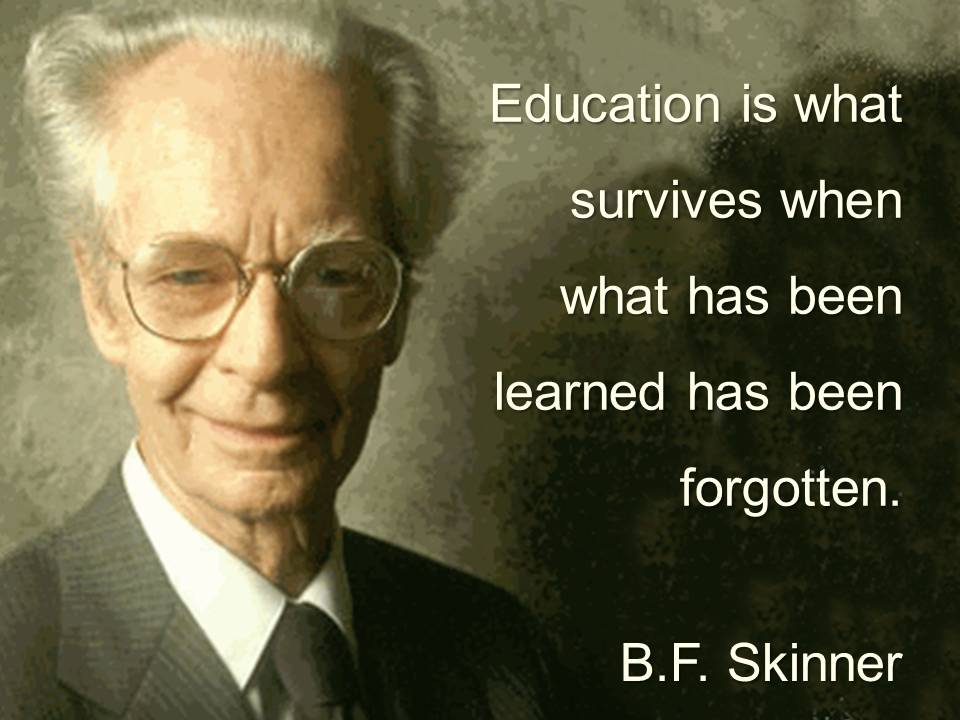
Dava Sobel comes bearing big news, you guys: B.F. Skinner is dead! Who knew, right? Well, anyways, the article was written in 1990, so at the time it was news. The NYT article "B.F. Skinner, the Champion Of Behaviorism, Is Dead at 86" was published on August 20, 1990. Click here to read all about the life and death of the famous Skinner. Love him or hate him, admit it: we've all learned something from him! (nudge, nudge)
Let's discuss, shall we? "Dr. Skinner advanced the belief that individuals could understand themselves and build a better world only through systematic modification of their behavior according to scientific principles he promulgated [def: promoted]." What do you think of the behaviorism philosophy of Skinner? Do you think that's the only way that we can change ourselves?
Skinner became a behaviorist in the 20s, when the discipline was just in its infancy. He turned behaviorism into a behavioral psychology of laboratory science and as a philosophy. If you think about it, behaviorism is sort of a philosophy.. In order to get the sort of data that he did, Skinner conducted all sorts of experiments; some were more humane than others. He was sometimes seen as a "cold manipulator of humanity" whose ideas could have "disastrous consequences" if they fell into the wrong hands.What do you guys think? What he over-manipulative? Mad scientist or truth-seeker?
Everything was a behavior, according to this guy. Even thinking was a behavior- no matter how hard it was to observe and describe.
Dr. Skinner's most important achievement was "his full explication of the theory of operant behavior." We know all about this from the book and class. Yay. In his 1938 book "The Behavior of Organisms," Skinner writes about "schedules of reinforcement" that sustain established behaviors.
According to Skinner, punishment was ineffective in training animals, teaching children, or managing public offenders. Do you all think punishment is an effective tool?
Skinner - What do you think?
"All human beings are controlled, but the ideal of behaviorism is to eliminate coercion, to apply controls by changing the environment in such a way as to reinforce the kind of behavior that benefits everyone." -BF Skinner
Skinner majored in English, wrote for the literary magazine, and dreamed of becoming a novelist. Robert Frost wrote encouraging words about his short stories! And yet... he said "I had no reason to write anything; I had nothing to say." Weird, right? Cool,though. Gotto love an English major! Apparently all his short stories paid careful attention to human behavior, which led him to apply to Harvard to become a psychologist.
For more on Skinner, don't forget to read the article!
With the play approaching in a matter of days, I don't think this post could be more appropriate. As most people who have been in plays/performance arts know, stage fright happens and when it happens, it's not fun. What is stage fright? Did it serve a purpose a long time ago? How can we get over it? Ironically, TED-Ed the Magnificent compiles the answers to all of these questions in a video!
As the video said, stage fright is a result of the evolutionary desire to be seen as strong. When we feel threatened, our bodies go into ultimate survivor mode, or the fight-or-flight response. Our minds don't see the speech or play as a modern thing with no physical danger attached to it. Instead, our brains have to decide whether to run for our lives or fight to the death against the scary monster. And, yes, public speaking is the scary monster in this scenario. Our bodies instinctively react. Knowing this, how do we get over stage fright? Perspective.
I could not have asked TED-Ed for a more Mrs. Perl answer. Yay! Anyway, what we need to change is our own perspective on performance anxiety. The John Lennon example shows that stage fright doesn't always go away with time or practice. Some people are just genetically predisposed to get more nervous before performances. In Maid in Manhattan, one of my favorite movies, Ralph Fiennes' character played with a paper clip while he was speaking in public. This helped him calm his nerves.
Practice is the second step after the perspective change. As the video said, if you practice in an environment similar to the environment you will be performing in, everything will go much more smoothly on the day of the event. At the end of the video, you will notice that it says that you have not conquered stage fright but have adapted to it instead. Food for thought, no?
With the play only two days away and the last dress rehearsal tomorrow, I would encourage everyone who gets nervous before a performance to try this method of adapting to stage fright. I tried it a few weeks ago at skating and it worked for me. Please feel free to share your thoughts in the comments. :)
Emotional intelligence. Apparently this is a thing and we all want it. Emotional Intelligence, known as EQ, is made up of 4 skills and affects our decision making, how we act in social situations, and how we manage our behavior. The 4 skills that make up EQ are self awareness, self management, social awareness, and relationship management. EQ is a set of skills that we can improve upon and strengthen during our lives--its not like an IQ that you are born with. Anyway, Forbes says we all want to have the highest emotional intelligence possible--apparently it makes for a better life. And if Forbes says so, then I believe it. So, why are we discussing EQ? Because one of the biggest killers of our EQ is one of the drugs we recently discussed in class?
What do you think it is? One of the crazy hallucinogens? LSD since I seem to bring that up a lot? Cocaine? Meth? No, all wrong.
Caffeine? Ding Ding Ding! You got it! Cutting down on your caffeine can actually increase your emotional intelligence!
The issue is, cutting down on caffeine for most caffeine drinkers is a pretty hard thing--I'm sure Mrs. Perl could attest to that. Caffeine can be pretty darn addictive. Let's discuss. Caffeine makes you feel alert by releasing dopamine and exciting neural activity. Studies have even shown that caffeine can actually improve cognitive task performance in the short term. BUT WAIT. It's not actually true! It's all lies! Here's what actually happens, according to the John Hopkins Medical School, when people stop consuming caffeine they go through a withdrawal making your cognitive performance worse and worsening your mood. When you go back on caffeine, you feel on top of the world (like most drugs) and your cognitive performance gets better--but its really just going back to normal.
Drinking caffeine, such as coffee, also triggers the release of adrenaline. Adrenaline, as we know, is the source of the fight-or-flight response which takes place in the parasympathetic nervous system. When we're in this mode, we tend to not make the most rational decisions--we just make quick decisions. Caffeine can put your body into a hyper-alert state, similar to when its in a fight-or-flight response making your emotions take over so you make irrational decisions and become irritable or anxious.
When we sleep, our mind clears and recharges. According to one theory for why we dream, our mind goes through all of the day's memories and decides whether to keep them or get rid of them. This makes us wake up more alert and with a clear mind. Having caffeine in your bloodstream makes it very difficult to sleep. Not getting enough sleep can have pretty negative effects on your memory, self control, alertness, and attention. Even if you do fall asleep, caffeine reduces your REM sleep which is when you are in deep sleep and you have the most vivid dreams. This lack of sleep, or quality sleep, makes people feel emotionally drained and sluggish in the morning causing them to go for more caffeine which makes your body produce more adrenaline which only makes it worse. The combination of the lack of sleep and caffeine make you feel more tired later in the day, causing you to need more caffeine which is why people still have it in their bloodstream when they are going to sleep.
As many of us know, a Jewish celebrity came to visit us and talk to us about our inspiration in Judaism this past weekend. Mr. Charlie Harary is an Aish HaTorah inspirational speaker who talks about what is means to be Jewish, and other things having to do with Judaism.
At the Malava Malka on Saturday night, my parents told me that Charlie talked about neuroplasticity in Jewish teens. He was talking about the concept of נעשה ונשמע, that we must first do something and then figure out why we do.
The repetition of performing mitzvot and embodying a good Jew will create neuroplasiticity in our brains. For example, we are taught from childhood that on Shabbat evening we light candles to welcome the Shabbat queen. From doing this for years and years, you finally create a new neural pathway that helps us understand why we do it. First we must do the action many times that it becomes natural, and then we start learning about why we do what we do, we listen.
The concept of Neuroplasticity is that new neural pathways are always forming in our brains because of actions that we do over and over again. Until those neural pathways are formed in our brains, we are reminded week after week by some outside stimulus to light the Shabbat candles, but once that pathway is formed, it is an automatic function. Once those pathways are formed we can take a step back from the physical world and focus on the spiritual world and listen and learn to why we light Shabbat candles to bring in Shabbat.
Most people in America drink coffee. In fact if I would to want to buy into a business that has a high chance of not failing it would be Starbucks. What is this huge phenomenon that every one wants. Why is it that every house has a kireg machine? There is no way around it, there are millions of people addicted to coffee. The truth is, there not addicted to the coffee, they are addicted to the drug that's in it. Caffeine. The drug that no one associates as a drug. The drug that has taken over people lives.
What is with caffeine that makes it so great? So addicting? Is caffeine bad for you? Is it good? Most people don't think about those question. So let me try to enlighten the few people who read this blog all about the truth to caffeine.
Caffeine works by stimulated the central nervous system, heart, muscles and blood pressure. It is a stimulate drug. That is what it does. Therefore if someone is tired they will want caffeine so it can speed them up. It helps a lot with mental awareness. This is all good accept that there is a huge negative side to caffeine.
1. It is addicting. Your body gets used to the caffeine stimulating it and stops stimulating its self. Then you start to feel more tired so you just have more caffeine. Before you know it you will need 3 cups of coffee just to make it through your morning.
2. Lots of people say " I just drank coffee I am going to need to use the bathroom in a minute". That doesn't mean it is speeding up your metabolism. It is actually doing really bad thing to your body. Caffeine stimulates peristalsis. The processes of food going to through your digestive track. So instead of breaking it down quicker it sends food out of the stomach into the intestines with out it being fully broken down. This causes you to not get the full nutrients of the food and it gives you higher risk of irritation and inflammation within the gastrointestinal tract.
3. There are many small side effect to caffeine that people don't know about still and scientist haven't figured out yet.
After learning all this I probably will still have my coffee. Will you? Do you think that caffeine is actually bad for you or that people are just making a bigger deal out if it then it really is? Do you think caffeine is a drug that is ok to have as much as you want? Do you think there should be an awareness to the negativitys of caffeine?
In 1943, Albert Hofmann reported perceiving "an uninterrupted stream of fantastic pictures, extraordinary shapes with intense, kaleidoscopic play of colors." Hofmann, a chemist, created- and on one Friday afternoon in April 1943 accidentally ingested- LSD (lysergic acid diethyl amide). The result reminded him of a childhood mystical experience that has left him yearning for another glimpse of a "miraculous, powerful, unfathomable reality." LSD, a synthetic hallucinogen, unlocks serotonin channels that normally filter sensory experiences and therefore causes sensory overload.
I found this article that describes the effects of LSD. It's definitely interesting.
It's often said that LSD causes hallucinations, but LSD really changes the way people perceive the world surrounding them, as well as what they think and feel. People on LSD see what's actually in front of them in an different way, and most of the time, are aware that their perceptions have been altered by the drug.
After taking LSD, the effects, known as a "trip," typically start within an hour and can last up to 12 hours, with a peak about halfway through. LSD can affect each person differently. Some physical changes in the body during "tripping" include dilated pupils, increased blood pressure and a high body temperature. People on LSD may also feel dizzy, sweat, have distorted vision and feel tingling in their hands and feet. They may feel drowsy but not sleepy.
LSD's major effects are visual. Colors seem more intense and lights seem brighter. Objects that are stagnant might appear to move or have a halo of light around them. Sometimes objects have trails of light coming from them or appear smaller or larger than they actually are. LSD users often see patterns, shapes, colors and textures. Sometimes it seems that time is running backward, or moving very quickly or slowly. On very rare occasions (although it's sometimes portrayed as common), tripping can cause synesthesia. Some people have described this as seeing colors when they hear specific sounds.
There is an overall sense of happiness and elation. Everything is delightful, wonderful, and magical, filled with unicorns and rainbows. People on LSD often become very emotional and dreamlike. Large doses of LSD make them feel especially pensive. They feel that their mind has burst through the limits of normal boundaries, and they often declare to have had experiences that are spiritual or religious, with a new understanding of how the world works.
People tripping on LSD are generally impulsive and have very poor judgment. This is part of the reason why LSD users prefer to trip in groups, especially with others who have experience, and in serene places like at home or in a park. For people not tripping but are merely spectating, LSD users can be frightening. They might spend lots of time contemplating something that appears incredibly unimportant. They aren't always easy to understand, but when they do talk, they speak quickly and jump from subject to subject.
What I mentioned above are considered to be "good trips." Most people who have used LSD know that there's always a looming possibility of having a "bad trip." It's not really clear what causes a bad trip, especially since each trip can vary depending on the person. LSD users sometimes say that it's due to the "set and setting." This means that if the user is already in a bad mood, or if the trip is in a structured environment that requires him/her to think logically (such as school), the user could have a bad trip. This may include losing sight of the delusory aspect of tripping, which results in fear and paranoia. The loss of control is terrifying, and it seems like the trip will never end. Sometimes when someone has a bad trip, he or she is taken to a hospital. However, there typically isn't much that doctors can do other than give the person a quiet space and reassurance. They may administer an anti-anxiety medication or a mild tranquilizer to ease the patient's trepidation. As the trip ends, the patient may feel dizzy or nauseous, but people usually recover with no lasting side effects.
For some, one bad trip is enough to swear off LSD forever. Even if LSD users don't have a bad trip, heavy use of LSD can still cause a lot of problems. One of the largest issues are its possible lingering effects, which can cause a reaction to the drug randomly again in the future. This suggests that the brain holds and may release molecules of LSD over time, and some believe that this is what causes "flashbacks." A flashback occurs when a person who has used LSD in the past has an experience, lasting anywhere from seconds to hours, similar to that of an actual trip. Some LSD users enjoy them and regard them as "free trips," while others find them incredibly disturbing. The majority of LSD users report never having flashbacks, and some people claim that they don't really exist.
Any who, for your convenience I have attached a picture of what a "trip" of LSD may look like.
There is no question that drugs do bad things to people. However, there are also interesting benefits that sometimes come up from drug usage. There is an unusual article that I stumbled across which claimed that the negative effects of DMT, a psychedelic drug closely related to LSD, are really being overly dramatized, and that the benefits of DMT outweigh the hazards. DMT occurs naturally in the brain, after all, so larger doses wouldn't be doing anything that out of the ordinary, states the author. DMT is known as the "spirit molecule" because it is behind dreams and the sensation a person has when they are in a near-death experience. It is produced in small quantities in the Pineal gland in the brain.
The author argues that psychedelic drugs help people dig deeper within themselves and solve "the mysteries of the universe," if you will. He claims that this chemical gives people an advanced amount of inner sight. He then goes on to list famous people who were taking this type of drug when they made amazing discoveries and count it as one of the best decisions of their lives, namely Francis Crick, Dr. Kary Mullis, and Steve Jobs. [Personally, I would add the makers of Spongebob and perhaps the Beatles to this list.]
Here comes the breaking point: the conspiracy theory. If you were hanging on up to this point, I am sorry to tell you that I fund any shred of credibility in this argument to fly out the window. The author claims that prohibiting substances such as LSD stop the public from fully grasping issues and getting a more in-depth look at the world around them. Since the government wants obedient followers who will take their word for everything, not allowing them to take psychedelic drugs and "see the truth for themselves" ensures that they will stay this way. Enjoying you life is rather important, and evidently the "LSD experience" is one such pleasure that can't be missed.
So much for the jumping out windows bit and permanent brain issues- apparently the government is restricting LSD because they don't want us to know more than them or "see the light" out of a drug-induced haze. Just when you had hope in your leaders...it has been shattered. I am truly sorry that we are not able to know the realities of life- perhaps sometime it shall all be revealed. I
Hope you got some enjoyment out of this, I certainly found it entertaining. For your reading pleasure I have attached the link: http://www.knowledgeoftoday.org/2012/02/expansion-of-consciousness-dmt-spirit.html
I was recently watching something that made a reference to tobacco addiction in pets, and the effects it can have. This ties in greatly with what we have been learning about addiction, as well as a reiteration of the idea that things have biological, psychological, and social components. As it turns out, smoking, in fact, has surprisingly similar effects on animals and people. Interestingly, animals who have become hooked on tobacco and that show signs similar to human smokers is not a new or unusual phenomenon. In fact, it is common for pigeons in New York to actually be addicted to the Nicotine in cigarettes, because there is so much of it present in the air. In fact, they may even consume an amount similar to a person that smokes a pack a day. Not only this, but they show signs of addiction as well. As one source states, ""We immediately noticed a large majority of the pigeons display external signs of chemical addiction. They are often found standing in a group outside of a building. They twitch often and look around with sharp turns of the head. They have anti-social tendencies and are quick to fly when confronted. Their breath smells terrible and they leave droppings everywhere they go. After thorough research we have proven that 98% of pigeons in New York City are hooked on nicotine. Each of the birds in the study reek of smoke and are constantly fidgeting and adjusting their wings. We have also observed the hoarse, raspy mating calls of these nicotine-addicted birds." Crazy, isnt it? They also eat cigarette remnants that are left lying around. This has become such an issue that the last line in this source states, "Mayor Bloomberg has started a new program to help these city birds break their addiction. If you notice a pigeon displaying signs of nicotine addiction call 311 to report it and get it the help it needs." There are now addiction hotlines for birds, people. This is when it becomes rather evident that things have gotten out of hand.
When thinking what to post about this week, I thought I might write about sleep apnea. During sleep, people stop breathing (due to partial blockage of their airway) anywhere from 10-30 seconds. They then gasp for air. Due to this loss of air, they wake up momentarily - but they don't remember waking up. They can't have effective REM sleep and the effects of sleep deprivation start to kick in.
Researchers have started to suggest that the main active ingredient in marijuana, THC, can be used to treat sleep apnea. The article said as follows:
"THC stabilizes regular breathing during sleep, reduces spontaneous sleep-disordered breathing and blocks serotonin-induced exacerbation of sleep apnea, researchers report in the journal Psychiatry in January."
This is pretty interesting! Considering we're learning about both subjects, drugs and sleep disorders, it's pretty cool to see the two collide.
Could this be an appealing factor in the push for legalizing marijuana?
We know all about dreams. It is super cool and interesting. But where does day dreaming come into it?
Daydreaming is nothing like the dreaming we do while we are sleeping. Daydreaming is a form of mind wandering. It is a form of a power down state.
Most people spend a 1/3 of their wakening day you day dream. Its a gate way to a proposed reality. You can be creative in your dreams.
When you are day dreaming you are fully up. But instead of focusing on whats in front of you you change your focus. You focus on your thoughts and let your self wander. Someone who is never really that creative can become creative in their daydreams. If you always wish for a specif thing you might day dream about having it. It is away to escape reality. Some people think its bad to day dream. Teachers would yell at students who are day dreaming to focus. While it may not be the best thing to do during class it has many benefits. It lets are mind go wild. You can come up with the best ideas while day dreaming. It can put you in a better mood, and if you are going through something painful daydreaming can get your head of the pain. Daydreaming is a great thing that we all do. Whoopp whoop for day dreaming.
It's time for a regular NYT article, taken from the all-so-dependable "The Stone" section. This article, written by Gary Gutting is all about priming. "Psyching Us Out: The Promise of 'Priming'"- a very interesting article. And it isn't long. So don't fret, click here and read!
Have you guys hear of this priming experiment? (OF COURSE! Because you read the article..)? College students were asked to form various sentences from a given set of words. In one group people were given a set of words associated with older people (bingo, gray, Florida). The people in the second group weren't given those associations. Next each participant was instructed to leave the building by walking down the hallway. They were being timed without knowing it... and it turns out that the Test Group Old walked significantly slower than the control group. They were primed to walk more slowly. How weird is that! What do you think about priming? Have you ever been primed before, looking back now?
There are more priming examples. Needless to say, people have done a lot of research on priming. It's a subject that we like to learn about.
What can we really learn about priming? "It is often said that they overturn a long entrenched view of human beings as models of rationality." What do you think of this idea? Is priming really that powerful? Or is it other factors? A combination? r are we models of rationality after all? Priming experiments are thought to provide powerful new tools for influencing human behavior. This has led Forbes and Morningstar to cite value in what they call "behavioral economics".
Gutting asserts, though, that priming experiments "seldom tell us how important priming is in realistic situations." Knowing the effects under highly simplified and controlled laboratory conditions hardly helps us know the effects in real life, when conditions aren't all being controlled and there are so many other unrelated stimuli constantly influencing us. Additionally, "there is seldom any reason to think that even a strong priming effect will last very long." So, really what is the significance of priming? Is it something we should continue to study and look into? What do you think we might end up gaining by further exploration of priming? if anything.. Even John Bargh, a main researcher on priming, admitted in 2006 that priming experiments had the problem of "ecological validity." Do you think that some priming is just common sense? Like the examples with the super markets and credit cards?
Personally, I am a little ehh about the whole thing. I think the experiments are really cool- I almost don't really believe them- but I have yet to note how they have much relevance on my life, especially if they don't have lasting effects.
Guys... We spend six years of our lives dreaming. Six years. With all this time spent dreaming, shouldn't we make it interesting? That's where lucid dreaming comes in.
Many of you may have heard of the idea of lucid dreaming. That's probably because it's a super cool phenomenon. Lucid dreaming happens when you are aware of the fact that you are dreaming and can therefore control what happens in your dreams. So, how can you make this happen? Actually, anyone can have lucid dreams with a little practice.
When you wake up in the morning, immediately record your dreams from the night before in a dream journal. Make sure to do this right when you wake up, or you will forget the content of your dream within just a few minutes. Next, make sure do regularly do "reality checks" throughout your day. Make sure the time of day is right and tick on regularly. Count something, turn away, and count it again to make sure it is the same. These reality checks reassure you that you are not dreaming, but you are awake and in reality. If you make this a habit, you will do reality checks in your dreams and consequently realize you are in fact dreaming. Also, when you find yourself falling asleep, try to picture one of your rent dreams and what would have happened if you could have controlled the dream The goal is to make yourself aware of the fact that you are actually dreaming! If you wake up in the middle of the night and try to fall back asleep, you may experience sleep paralysis (which was so wonderfully explained by Noga in her blog post) and then lucid dreaming.
Scientists disagree over the validity of lucid dreaming. Many believe that yes, it is possible and can happen to anyone. Others refute that claim as nonsense.
Here is a lovely informational videos:
Given what we have been learning about sleep, do you guys think this is possible? Has it happened to you? Would you like to try it? I certainly would. I would definitely go swimming with the sea turtles. What would you do if you could control your dreams?
As we finally end Unit 4 and the studies of sensation and perception, we turn to a more interesting topic- consciousness. We began Unit 5 by discussing the many properties of sleep. While learning about the cycles of sleep is all fine and dandy, I really wanted to focus on sleep walking.
However, as a review, I'll go over the sleep cycle. Let's say I decide to go to sleep at 10:30 (highly unlikely, seeing as I can't seem to find a way to fall asleep before 12). As I am laying in my bed, I'm in "Stage 0" of sleep, meaning that my brain is still emitting short, fast alpha waves. As I begin to drift off, I fall into Stage 1, with a mixture of slow and fast waves, then Stage 2, with spindles, and Stages 3 and 4, characterized by delta waves. Finally, as it becomes later and later, I pass into REM sleep, where my brain seems to be emitting small and fast waves like Stage 0.
During REM sleep, my body would be paralyzed while my mind is still awake, meaning I wouldn't be sleep walking at this stage. REM sleep is the sleep stage where dream occur. In Stages 2-4, I would have sleep thoughts, where I would think about simple experiences that occurred throughout the day, such as driving or reading.
So if sleep walking doesn't occur during REM sleep, when does it happen? During Stage 4, when we are in a state of deep sleep and our brains emit large, slow delta waves. My brother, Ahron, used to sleep walk on a usual basis when he was younger, meaning that I witnessed sleep walking many times. His adventures were usually characterized by crying, talking incoherently, and just being downright weird. I remember one night, a few years ago, I was in my parents room talking to my mom, and all of a sudden Ahron walks in holding his comforter. His eyes are open and his face is calm. He drops his blanket on the floor and says, "Can I leave this in here?" and then walks out. This particular night was memorable because it happened to be extremely hilarious.
I wasn't so keen on all the sleep walking business because it was creepy. Ahron would sometimes come into my room and ask me the most random things with a glazed look on his face, eyes open, and apparently awake, but in actuality he was sleep walking. One night, I had already fallen asleep and he came into my room and actually poked me awake and said, "Shani, where's the paper? I need the paper." Usually my dad would just tell him to go back to sleep, but my dad had already gone to sleep. In the morning, Ahron couldn't remember a thing.
Because sleep walking used to be a normal occurrence at my house, I wanted to explore it more deeply. According to webmd.com, sleep walking occurs most during childhood, usually around the ages of 4 to 8. This website also explains that sleep walking can occur as a result of genetics, such as if a close relative has a history of sleep walking, environmental factors like stress, sleep deprivation, and intoxication, and medical conditions like fever, asthma, reflux, sleep apnea, and PTSD. I'm pretty sure my brother did not have any of these conditions when he was younger, so I'm going to hazard a guess at the genetics factor. Either way, I find sleep walking quite intriguing.
When discussing sleep in class, I suddenly remembered hearing a story awhile back about someone who had a rare disorder that caused them to sleep for weeks. It turns out this disorder is called Kleine-Levin Syndrome. It is extremely rare, occurring at a rate of one in a million. It mostly occurs in adolescent males, and is interestingly prevalent in Jews in the United States and Israel.
KLS is often triggered by an infection such as the flu. The disorder causes the person to experience episodes of excessive sleep, up to 20 hours a day, which can last for a few days or even weeks. Those affected by KLS can also experience abnormally increased appetite (hyperphagia), increased sex drive (hypersexuality), and changes in mood and cognitive abilities. Some patients act very childlike during episodes. At least 80% of cases involve derealization (perception of the outside world seems unreal) and apathy. Afterwards, the person often cannot remember everything that happened during the episode.
The cause of KLS seems to be a mystery, though there are various theories:
1. Some doctors think it may have something to do with a malfunction of the hypothalamus, the part of the brain that controls appetite and sleep.
2. The thalamus most likely plays a role in the excessive sleep, the temporal lobe could be the cause of cognitive disabilities, and the symptoms of apathy and disinhibition point to dysfunction of the frontal lobe.
3. There is an imbalance in the serotonin and dopamine pathways.
4. Genetics could play a role since KLS is common in Jews and certain families.
5. KLS is an autoimmune disorder.
Stimulants such as amphetamine and methylphenidate can be prescribed to treat sleepiness, but can cause increased irritability and won't help restore cognitive abilities. As of now, lithium is the only drug that has been shown to prevent recurrences of KLS symptoms. If an individual with KLS goes six years without any symptoms they are considered to be cured.
Interesting article on a girl living with KLS: http://www.dailymail.co.uk/news/article-1249895/Louisa-Ball-Real-life-Sleeping-Beauty-sleeps-weeks-time.html
Imagine you're sleeping. Suddenly, your eyes open, and you see a demon lurking over you on your chest. It nears you. You want to run away, but you are unable to move. You are completely and utterly paralyzed, and you have just woken up into your dream. This is how the TED-Ed video, entitled The Terrors of Sleep Paralysis, begins.
Sleep paralysis has been experienced by at least half of the population at least once in their lifetime. This fear-inducing occurrence, where one comes face to face with their nightmares, can last from a few seconds to minutes. It can involve visual and auditory hallucinations of an evil spirit or an out-of body feeling. Some have mistaken sleep paralysis for a meeting with a ghost.
In 1867, Dr. Silas Weir Mitchell was the first medical professional to examine sleep paralysis. Although he was the first, it's so common that cultures all across the globe have formulated a paranormal explanation for it. In medieval Europe, it was common to think an incubus, a mythical creature, had visited the victim in the night. In Scandinavia, another creature who sits on rib cages was held accountable. In Turkey, strangling beasts tried to torture you. And, in the southern United States, a hag came for you.
Although it is easier to accuse mythical spirits, what's actually happening is much more difficult to explain. Modern scientists believe that sleep paralysis is caused by an atypical overlap of REM sleep and the waking stage. During a normal REM cycle, one experiences numerous sensory stimuli in the form of a dream, while the brain is unconscious and fully asleep. During the dream, special neurotransmitters are released, paralyzing the muscles. This is known as REM atonia. It's what prevents a person from physically reacting to being chased in a dream. During sleep paralysis, you experience normal components of REM; however, the brain is conscious and wide awake. This causes you to feel that you are experiencing an encounter with frightening presence.
During REM sleep, REM atonia, also removes voluntary control of breathing. Breathing becomes more shallow and rapid, causing one to inhale more carbon dioxide, and thus experience a small blockage of their airway. In sleep paralysis, a combination of the body's fear response to a perceived attack and the brain being awake triggers the body to take in more oxygen, and makes one gasp for air. However, one can't, because REM atonia has removed voluntary control. This experience creates the perception of pressure on the chest, or suffocation.
Sleep paralysis has been linked to narcolepsy. However, people who experience it usually do so infrequently, perhaps only once in their lifetimes. So, sleep well, knowing that the evil creature is not actually coming for you.
Sleep occurs in five stages. About every ninety minutes, we pass through a cycle of these distinct sleep stages. This fact was unknown until Eugene Aserinsky experimented on his son using an EEG. He discovered what we know as REM sleep (rapid eye movement sleep), a recurring sleep stage during which vivid dreams frequently occur. It is also known as paradoxical sleep, because the muscles are relaxed (except for minor twitches), but other body systems are active.
Stage 1 of sleep occurs when we leave the alpha waves, or the relatively slow brain waves, of an awake, relaxed state. We then slip into sleep, a periodic, natural loss of consciousness- as distinct from unconsciousness resulting from a coma, general anesthesia or hibernation. During Stage 1, one may experience fantastic images (falling or floating weightlessly), resembling hallucinations, false sensory experiences, such as seeing something in the absence of an external visual stimulus. Such hypnagogic sensations may later be incorporated into memories.
After relaxing deeply, one begins about twenty minutes of Stage 2 sleep, characterized by the periodic appearance of sleep spindles- bursts of rapid, rhythmic brain-wave activity. Sleep-talking- usually garbled or nonsensical-can occur during Stage 2 or at any other sleep stage.
Then for the next few minutes, one goes through the transitional Stage 3 to the deep sleep of Stage 4. First in Stage 3, and increasingly in Stage 4, the brain emits large slow, delta waves, associated with deep sleep. These two slow-wave stages last for about 30 minutes, during which one would be hard to awaken. At the end of the deep sleep of Stage 4, children may wet the bed or begin sleepwalking. Stages 1-4 encompassed are known as NREM sleep (non-rapid eye movement sleep).
After about an hour, ones leaves behind the stages of NREM sleep, where one ascends from the initial sleep dive. Returning through Stage 3 and Stage 2 for about half the night, one enters REM sleep. For about ten minutes, the brain waves become rapid and saw-toothed. During REM sleep, heart rate rises, breathing becomes rapid and irregular, genital arousal occurs, and every half-minute or so the eyes dart around in a momentary burst of activity behind closed lids. Although the brain’s motor cortex is active during REM sleep, the brainstem blocks its messages, leaving muscles relaxed to the point where one is essentially paralyzed, and cannot be easily awakened. This is why REM sleep is sometimes called paradoxical sleep, with the body internally aroused and externally calm. The sleep cycle repeats itself every ninety minutes. During a normal night’s sleep, periods of Stage 3 and Stage 4 shorten and Stage 2 and REM sleep lengthen.
Anyways, I found this to be interesting.
Have you ever had this experience, or something similar? Share your thoughts in the comments below!
Dreams or more likely nightmares are reflections of real and everyday life. One of the 5 theories of dreaming is that dreams are a way to organize one's memories at night from life and the previous day. This theory suggests that, at night, our hippocampus releases experiences from the previous day and allows our brain to store them into the right place. Whether that be to throw them out or keep them for long term memory. More likely than not, our brain decides to keep the bad experiences and thoughts which is one of the causes of nightmares.
As I was surfing around the internet this morning, I found a video on youtube that explained the 10 most common nightmares and what causes them. A lot of what causes them can be explained by Freud's wishful thinking theory, in which latent content emerges and tells your messages while you sleep causing you to think about them.
Taking a test - The reason a lot of people dream about taking big tests and more often, failing a big test is because of lack or fear of self-confidence. This shows that a lot of us have a sense of being underprepared for what life throws at us and we are not able to reach our full potential.
A parter cheating on you - This nightmare occurs when you think your partner isn't paying enough attention to you. The latent content of this nightmare would be that you should spend more time with one another.
Flying - This shows that one always wants to be in control of his/her own destiny. This dream also shows that one always wants some sort of freedom. What happens when you start flying and you fall to the ground? This shows that we are out of control of our own destiny.
Dying - Some people believe that dreaming of death tells people that they need to make positive changes in their life. The nightmare of dying is similar to taking a test in which it indicates a sense of failure in life.
Spiders - Having a nightmare about spiders is usually telling you that you are being manipulated or you are manipulating someone else.
Being Naked in Public - When one feels too exposed or ashamed of themselves that often have this nightmare. This also shows that people find themselves socially inadequate, and vulnerable to ridicule.
Being Chased - This is sign that you are avoiding something in your life and are refusing to deal with a problem that you have.
Losing your Teeth - My grandma actually told me that she had this dream a couple of weeks ago. It indicates that you are insecure about your appearance and interactions with other people around you. It can also mean that you have a feeling of helplessness.
Being Lost - You are losing or have already lost your right direction in life. This dream can also relate to the fear of not fitting in.
Falling - This nightmare is similar to the dream of flying. When you are falling, this indicates that something in your life is out of control. This nightmare can also be linked to being betrayed by a trusted friend.
When I saw this video, I found it very interesting that people share the same nightmares because most of these fears engulf us in everyday life. This part of dreaming can be mostly linked to the social phenomenon of the Bio-Psycho-Social approach. Which nightmare do you have most often?