I always wanted to research Suicide. I never could grasp my head around how someone could kill themselves. I understand more to why they would want to, but actually being able to cause such harm to themselves baffles me.
I know a teenage boy from New York who jumped out of a window and killed himself. Hatzalah ( ambulance) was in the room while it happened. Trying to get him to not do it, but they were too late. Ever since then I wanted to know more about it.
More recently I was told a story about a family in New York who was making a wedding. One of the siblings was not so religious and the parents the day of the wedding said something like - unless you are wearing a normal suit and black hat do not come to the wedding. So the boy did not go. When the wedding was over they all came home to find that their son hung himself.
Both these stories are crazy and extremely sad. But it was more than what the people were saying. The first boy was just a regular teenager going through a depressing stage in his life. And there has to be more to the second boys story. No one killed themselves because they were shunned at what they were going to where. But I am not interested in the details. I wanted to understand how they were able to kill themselves.
While I was doing the research I came to the realization that its not them killing themselves. It is their mind, that has taken over their body, which is the one killing them.
You yourself does not have that ability.
The reasons that people commit suicide all lead to the mind taking over.
1. A severe depression. - there mind is telling them that everything in life is hopeless. It feeds the person sadness and doesn't let them have any dreams or hopes. They do not have a sense of purpose or want to fulfill a dream. The depression takes over and leaves them with thinking nothing but the present. The mind then has control and can lead the body to do what it wants.
2. There psychotic. - They have voices in their head telling them what to do. Once again it is not them. There mind is making up voices. That is what is leading them to kill themselves. They feel the need to listen to exactly what the voices says.
3. They are impulsive. - meaning there on drugs or alcohol. We all know the effects of some drugs. It takes you over. You are now the drug not yourself. The mind is warped signals are being stopped or transmitting to fast. If you think about killing yourself your drugged up brain might then make you do it without thinking.
4. Philosophical reason. - This is usually only when someone is terminally ill. People like to be in control. When they aren't they crave it. When they are not in control over their sickness their minds starts acting out. They begin to think that they only way that they can have control is for them to decide when they die not the illness. Their minds want to feel in charge and in control and by killing the person who they are controling before the illness does they do just that.
5. They have made a mistake- Someone did something that they should not have. They were vulnerable. Once again its a control problem. The mind was wrong, it did not have enough control over the person to make sure they didn't commit the mistake. So it goes nuts. It guilts the person and makes them feel horrible about it. Then it makes the person kill themselves so they are in control. No more mistakes can happen.
There are many other reasons for suicide. Some that makes sense and others that are hard to understand.
I think though suicide is a sad an crazy thing and I do believe It is not really the person killing themselves but their mind taking over and killing them.
It could be my theory is bogus though, what do you think?
Friday, March 14, 2014


Postpartum Schizophrenia
Postpartum psychosis is something that mothers can get after giving birth. It can occur moment after giving birth or months later.
Mothers can have a hard time sleeping. They claim to hear voices and see things that are not really there. They can have mood swings and random attacks of doing something at a weird time like cleaning the house in middle of the night. They can feel disconnected from reality and confused.
They do not know who for sure will get it. Mothers who have it in their family are more likely to get it. If you had an illness during pregnancy you are more likely to. As well as mothers with depression or schizophrenia.
Postpartum Schizophrenia is an extreme case of postpartum psychosis and the mother had schizophrenia. The mother can feel really insecure about her baby once it is born. This can lead to the mother killing her own baby.
Have no fear though, postpartum psychosis can be treated. The early it is detected the better. It is treated with antipsychotic and antidepressant drugs. As well as counseling. It can take a few weeks until they are almost fully recovered.
Do you think that having other psychological disorders will have an effect on whether or not you get postpartum psychosis. Does this change the way you look at stories about mothers that harmed there own babies? Maybe they really had a psychological problem that was not being treated?
Mothers can have a hard time sleeping. They claim to hear voices and see things that are not really there. They can have mood swings and random attacks of doing something at a weird time like cleaning the house in middle of the night. They can feel disconnected from reality and confused.
They do not know who for sure will get it. Mothers who have it in their family are more likely to get it. If you had an illness during pregnancy you are more likely to. As well as mothers with depression or schizophrenia.
Postpartum Schizophrenia is an extreme case of postpartum psychosis and the mother had schizophrenia. The mother can feel really insecure about her baby once it is born. This can lead to the mother killing her own baby.
Have no fear though, postpartum psychosis can be treated. The early it is detected the better. It is treated with antipsychotic and antidepressant drugs. As well as counseling. It can take a few weeks until they are almost fully recovered.
Do you think that having other psychological disorders will have an effect on whether or not you get postpartum psychosis. Does this change the way you look at stories about mothers that harmed there own babies? Maybe they really had a psychological problem that was not being treated?
Thursday, March 13, 2014
What If They Didn't Exist?
This week in AP Psychology, we learned about psychological disorders, Axis I and II of the DSM-IV-TR. The first type of psychological disorder is anxiety. Within anxiety, there are 5 different disorders that one could obtain. However, first things first, anxiety itself must be defined. Anxiety is basically just sympathetic nervous system arousal, aka the fight-or-flight response. When anxiety comes in the form of the fight-or-flight response, meaning when there is actual stimulation, then it can be a tremendous help. However, it is when your sympathetic nervous system is constantly aroused and your body is in constant activation, especially with the absence of stimulation, that it becomes a real problem.
The first type of anxiety is generalized anxiety disorder, where one feels the physiological symptoms of the fight-or-flight response over everything. There is constant worry, and usually, the person makes a huge deal when there really isn't anything there. The second, more well-known disorder, is that of phobia. Phobias are fears that take over your life, your thoughts, and your dreams. Usually, the fear is irrational, and it is only when it negatively impacts your like that it becomes a phobia. Sometimes, there are specific triggers such as snakes or dogs. Two examples of phobias would be agoraphobia, the fear of going outside, and social phobia, where one is anxious in social situations.
Another well-known disorder is obsessive-compulsive disorder, better known as OCD. This disorder does not contain the components that people usually think it does. Being super neat does not mean that you have OCD. As an anxiety disorder, it involves having obsessive thoughts, which later develop into anxiety. You then develop compulsion, or actions, to relieve that anxiety. You constantly use those compulsions to get rid of the constant worrying. For instance, you would check the door 54 times to make sure that it is locked before going into a different room. Being neat is one thing, but when you continuously act in a certain obsessive way, so much so that it beings to impact your life, then it becomes a disorder.
The last two disorders are post-traumatic stress disorder and panic disorder. Post-traumatic stress disorder is most common among veterans and those who have experienced major trauma. It usually involves major anxiety, flashbacks, and mental paralysis. Those with PTSD simply cannot function in life. Panic disorder is basically anxiety on steroids. You basically feel like you are going to die and you stop breathing. Sometimes these panic attacks are caused by something, but sometimes they're just completely random. One of the most debilitating aspects of panic disorder is the fear of having another panic attack.
When learning this, I thought of an example of PTSD that I had seen in my dad's favorite TV show, The West Wing. Basically, this show revolves around the life of the president (though not the actual president, of course). The White House Chief of Staff, Josh Lyman, is shot in the first season finale while protecting the president's aide, Charlie. He has to go through surgery for 14 hours and ends up being put through psychotherapy after showing signs of PTSD, which included yelling at the president in the Oval Office and smashing a window in his apartment.
Stories like these make me increasingly thankful that I haven't been diagnosed with anything of that magnitude. Wouldn't the world be a much simpler place if psychological disorders didn't exist?

The first type of anxiety is generalized anxiety disorder, where one feels the physiological symptoms of the fight-or-flight response over everything. There is constant worry, and usually, the person makes a huge deal when there really isn't anything there. The second, more well-known disorder, is that of phobia. Phobias are fears that take over your life, your thoughts, and your dreams. Usually, the fear is irrational, and it is only when it negatively impacts your like that it becomes a phobia. Sometimes, there are specific triggers such as snakes or dogs. Two examples of phobias would be agoraphobia, the fear of going outside, and social phobia, where one is anxious in social situations.
Another well-known disorder is obsessive-compulsive disorder, better known as OCD. This disorder does not contain the components that people usually think it does. Being super neat does not mean that you have OCD. As an anxiety disorder, it involves having obsessive thoughts, which later develop into anxiety. You then develop compulsion, or actions, to relieve that anxiety. You constantly use those compulsions to get rid of the constant worrying. For instance, you would check the door 54 times to make sure that it is locked before going into a different room. Being neat is one thing, but when you continuously act in a certain obsessive way, so much so that it beings to impact your life, then it becomes a disorder.
The last two disorders are post-traumatic stress disorder and panic disorder. Post-traumatic stress disorder is most common among veterans and those who have experienced major trauma. It usually involves major anxiety, flashbacks, and mental paralysis. Those with PTSD simply cannot function in life. Panic disorder is basically anxiety on steroids. You basically feel like you are going to die and you stop breathing. Sometimes these panic attacks are caused by something, but sometimes they're just completely random. One of the most debilitating aspects of panic disorder is the fear of having another panic attack.
When learning this, I thought of an example of PTSD that I had seen in my dad's favorite TV show, The West Wing. Basically, this show revolves around the life of the president (though not the actual president, of course). The White House Chief of Staff, Josh Lyman, is shot in the first season finale while protecting the president's aide, Charlie. He has to go through surgery for 14 hours and ends up being put through psychotherapy after showing signs of PTSD, which included yelling at the president in the Oval Office and smashing a window in his apartment.
Stories like these make me increasingly thankful that I haven't been diagnosed with anything of that magnitude. Wouldn't the world be a much simpler place if psychological disorders didn't exist?
(Josh after smashing the window in his apartment)
Tuesday, March 11, 2014
Reciprocal Determinism
I want to go back to personality for a minute because we learned something that I found to be particularly interesting.
The social-cognitive perspective of personality takes into consideration internal/cognitive factors, behavioral factors, and environmental factors when exploring personality. One aspect of this perspective is the idea of reciprocal determinism- that a person's behavior is determined by personal factors as well as social and environmental factors. A person's behavior is influenced by the individual as well as the environment and social stimuli he/she encounters. In other words, what a person offers up is what a person gets in return.
I found this concept to be incredibly relatable to my life. One example- when I was on the Miami basketball tournament I noticed that a girl I go to camp with was also there with her team. We aren't particularly close, so it wasn't like I was that excited to see her. We both knew each other was there, but for some reason we never said hi until I ended up going up to her on the last night of the tournament. Now, why is this? Perhaps because I chose not to say hi, she chose not to say hi. It's like she was thinking "Well why won't Lily say hi to me?" and I was thinking, "Why won't Naomi say hi to me?" Perhaps we each expected the other to make the first move, which obviously means neither of us would make the first move. This kind of situation happens to me all the time. Especially in social situations. If I walk into a party and fail to greet someone in the first couple minutes, I feel as though I can't say hi to them after that, and perhaps they interpret my failure to acknowledge them as hostility and therefore refrain from saying hello to me. This also gets into optimism vs. pessimism cycles.
What's even more fascinating is that this could be expanded into even bigger terms. If a person really gets back what they put out, an ugly, badly behaved child may be treated differently throughout their childhood and have a generally negative outlook on life. It's all about the interaction between the person and the environment. Reciprocal determinism is essentially a never ending cycle.
The social-cognitive perspective of personality takes into consideration internal/cognitive factors, behavioral factors, and environmental factors when exploring personality. One aspect of this perspective is the idea of reciprocal determinism- that a person's behavior is determined by personal factors as well as social and environmental factors. A person's behavior is influenced by the individual as well as the environment and social stimuli he/she encounters. In other words, what a person offers up is what a person gets in return.
I found this concept to be incredibly relatable to my life. One example- when I was on the Miami basketball tournament I noticed that a girl I go to camp with was also there with her team. We aren't particularly close, so it wasn't like I was that excited to see her. We both knew each other was there, but for some reason we never said hi until I ended up going up to her on the last night of the tournament. Now, why is this? Perhaps because I chose not to say hi, she chose not to say hi. It's like she was thinking "Well why won't Lily say hi to me?" and I was thinking, "Why won't Naomi say hi to me?" Perhaps we each expected the other to make the first move, which obviously means neither of us would make the first move. This kind of situation happens to me all the time. Especially in social situations. If I walk into a party and fail to greet someone in the first couple minutes, I feel as though I can't say hi to them after that, and perhaps they interpret my failure to acknowledge them as hostility and therefore refrain from saying hello to me. This also gets into optimism vs. pessimism cycles.
What's even more fascinating is that this could be expanded into even bigger terms. If a person really gets back what they put out, an ugly, badly behaved child may be treated differently throughout their childhood and have a generally negative outlook on life. It's all about the interaction between the person and the environment. Reciprocal determinism is essentially a never ending cycle.
Angel and Devil
In Freud's psychoanalytical theory of personality, he organizes personality into three categories: the id, the ego, and the superego. He says that every person has a struggle between the id, the ego, and the superego. As we develop these, our psychosexual development also occurs. If problems occur while these are our psychosexual stages are developing, then fixation occurs. If the id and superego are unbalanced, you experience anxiety.
Id: According to Freud's theory we are born with an id. The id allows us to get our basic needs med. It is based on the pleasure principal. The id doesn't consider the reality of any situation, it wants whatever will make it feel good at that time. When the child needs something, the id complains, and the child gets what they want. The id doesn't care about what others want, only about what it wants at that moment.
Ego: When the child interacts more with the world and people, the ego begins to develop. It is based on reality. It understands that other people also have needs and desires and being selfish will just hurt us in the long run. The ego satisfies the needs of the id, while looking at the reality of a situation as well.
Superego: By the age of five it develops. The superego is our morality. It develops due to the moral and ethical limitations that our parents give to us. The superego is what lets us know between right and wrong.
According to Freud, a healthy person will have the ego as the strongest out of the three where it will satisfy the needs of the id and at the same time, not upset the superego and still be able to see the reality of every situation. If the id is too strong, the want for pleasure will take over the person's life. If the superego becomes too strong, the person will be too driven by morals. The id is seen as the angel on the shoulder and the superego is seen as the devil on the shoulder. The ego is seen as the person who has the "angel" and "devil" on his shoulders.

Monday, March 10, 2014
There are many intelligence test all over the internet. Quizzes and surveys that after tell you how you score. They usually are based of what the average score in general is.
Here is a link to two such test. Try it and let us know how smart you are ;)
http://intelligence-test.net/part1/
http://www.begent.org/intelquiz.htm
How much are these intelligent test accurate. What are they based of. Do they have an similarities to an IQ test.
Most intelligent test that are giving on line aren't really accurate. The questions are often not thought out and the answers can be easily skewed. If they are basing your score off the average person, you don't know for sure that they are not looking up the answers or having help.
Most of the test do use the IQ test as the base of their testing. The IQ is the most standard test so of course they look to it for guidance.
The test online are just for fun and don't really have anything accurate about them. So if you took the quiz and you got a low score- have no fear, they aren't always accurate. If you got a high score- the test might be accurate so you know it must prove that you are as smart as you know you are. :)
Here is a link to two such test. Try it and let us know how smart you are ;)
http://intelligence-test.net/part1/
http://www.begent.org/intelquiz.htm
How much are these intelligent test accurate. What are they based of. Do they have an similarities to an IQ test.
Most intelligent test that are giving on line aren't really accurate. The questions are often not thought out and the answers can be easily skewed. If they are basing your score off the average person, you don't know for sure that they are not looking up the answers or having help.
Most of the test do use the IQ test as the base of their testing. The IQ is the most standard test so of course they look to it for guidance.
The test online are just for fun and don't really have anything accurate about them. So if you took the quiz and you got a low score- have no fear, they aren't always accurate. If you got a high score- the test might be accurate so you know it must prove that you are as smart as you know you are. :)
David the Antisemite Jew
In Psychology class, when we learned about Freud's defense mechanisms, it reminded me of a person who we saw a movie about in Ivrit. Freud's defense mechanisms are more socially acceptable behaviors that you perform unconsciously in order to prevent anxiety. Freud's defense mechanisms are
In Ivrit class, we learned about a man whose whole family grew up as anti-Semites. The family led groups of antisemitism and told other people about how bad the Jews were and how they are the causes of many horrible things. David, who was the son of a huge anti-Semite father and unknowingly the son of a Jewish mother. So David, unknowingly was a Jew himself. He was a big anti-Semite who was also a Jew.
David's story reminds me of the defense mechanism of reaction formation. The person was an anti-Semite even though he was a Jew. He was acting as an anti-Semite, even though he was unknowingly a Jew. He was unconscious about the fact that he was a Jew, so he acted the opposite of what he actually was.
- Repression: banishes anxiety-arousing thoughts, feelings, and memories from consciousness.
- Regression: an individual faced with anxiety retreats to a previous psychosexual stage, where some physic energy remains fixated.
- Reaction formation: the ego unconsciously switches unacceptable impulses into their opposites.
- Projection: people disguise their own threatening impulses by attributing them to others.
- Displacement: shifts sexual or aggressive impulses toward a more acceptable or less threatening object or person, as when redirecting anger toward a safer outlet.
- Sublimation: people rechannel their unacceptable impulses to a socially approved activity.
- Denial: people refuse to believe or even to perceive painful realities.
In Ivrit class, we learned about a man whose whole family grew up as anti-Semites. The family led groups of antisemitism and told other people about how bad the Jews were and how they are the causes of many horrible things. David, who was the son of a huge anti-Semite father and unknowingly the son of a Jewish mother. So David, unknowingly was a Jew himself. He was a big anti-Semite who was also a Jew.
David's story reminds me of the defense mechanism of reaction formation. The person was an anti-Semite even though he was a Jew. He was acting as an anti-Semite, even though he was unknowingly a Jew. He was unconscious about the fact that he was a Jew, so he acted the opposite of what he actually was.
Sunday, March 9, 2014
Should Obesity Be a 'Disease'?

You can probably already guess what the article is going to be about based on the title, so why don't you go ahead and think about it before you go on- Do you think obesity should be considered a disease? Click here to read the original article (whose title I stole) written by Crystal L. Hoyt and Jeni L. Burnette.
The American Medical Association labeled obesity a "multi-metabolic and hormonal disease state." The pros of this decision: calling obesity a disease provides a clear warning of the significant health risks associate with excessive weight. Plus it sparked interest and more research is funded aimed at finding medically driven remedies.
What would the psychological ramifications be, though, of marking obesity as a disease? "Would it empower people to fight back, or lead fatalistic acceptance of being overweight?" What do you guys think?
Well, the writers of this article were as curious as we are, so they decided to go out and experiment! Using random assignment, controls, and all that good stuff indicating a sound scientific experiment, they went out to see what kind of message this new A.M.A decision is sending. Their findings? The new "disease" label increased body satisfaction among obese individuals (they speculate this is because it removed the shame of obesity as a moral failing. Agree/Disagree?). They also found that suggesting one's weight is a fixed state- like a long term disease- "made attempts at weight management seem futile, and thus undermined the importance that obese individuals placed on health-focused dieting and concern for weight."
There are two issues at conflict here, really. On the one hand, we don't want people suffering from obesity to feel ashamed of themselves and self-blame. On the other hand, we want to promote weight loss. What is the best way to fight against obesity? The writers of this article aren't completely sure, so it's okay if you don't have an answer. But it's still an interesting issue to think about. Like the article said, when there's a combination of physiological and psychological conditions, there will be complications and trade-offs. It's all nice and swell when we're reading our dandy psych books and we read about bio-pshycho-social models in theory. But what about real-world applications? Things aren't always so simple. Unfortunately.
As we know, there are many different factors that go into obesity. Based on your knowledge on obesity from class and the new factors added by this article, I shall ask you again- do you think obesity should be considered a disease? I can't make up my mind about this one. I see both sides. I think they definitely need to conduct more studies. If it's true that people with obesity who see obesity as a disease don't try to live healthier lives, then I think that it might be counter-intuitive to have the label. I guess we'll see what happens! I'm sure this won't be the first we'll be hearing of this in years to come...
Unprecedented IQ
This past week we learned about the bell curve of intelligence. Along with this we leaned that anyone with an IQ between 70 and 130 give or take 10, is average. But what about those people who are in the 3% of people who have higher IQ's than 130.
One of these geniuses, probably the most well-known, is Albert Einstein. Einstein was born and grew up in Germany. On his way to fame, Einstein published so many papers and complex works that displayed his amazing, and unprecedented intelligence level. Einstein had an IQ of 165 which is in the portion of the population that is less than 1%.
While Einstein was a genius in Physics, another famous man was gifted with musical talents. Wolfgang Amadeus Mozart was a gifted musician with the same IQ as Einstein. One might not think that a classical musician could ever have the same IQ as Einstein, but this proves that multiplists have a pretty accurate idea of intelligence. A multiplist believes that a person can be extremely gifted in one area, and not as much in others. Mozart was VERY gifted in music, but wasn't necessarily gifted in school smarts, like Einstein was.
Especially from Mozart, we can learn that having a really high IQ isn't always icing on the cake, but it does give us a flair that makes each of us individual and who we are.


One of these geniuses, probably the most well-known, is Albert Einstein. Einstein was born and grew up in Germany. On his way to fame, Einstein published so many papers and complex works that displayed his amazing, and unprecedented intelligence level. Einstein had an IQ of 165 which is in the portion of the population that is less than 1%.
While Einstein was a genius in Physics, another famous man was gifted with musical talents. Wolfgang Amadeus Mozart was a gifted musician with the same IQ as Einstein. One might not think that a classical musician could ever have the same IQ as Einstein, but this proves that multiplists have a pretty accurate idea of intelligence. A multiplist believes that a person can be extremely gifted in one area, and not as much in others. Mozart was VERY gifted in music, but wasn't necessarily gifted in school smarts, like Einstein was.
Especially from Mozart, we can learn that having a really high IQ isn't always icing on the cake, but it does give us a flair that makes each of us individual and who we are.
Nathan and Nolan: Supersmart People Who Like Science and Math (Which I Don't Understand)
This past week in AP Psychology, we finished up learning about intelligence. While the whole thing about standard deviation was a bit difficult to grasp, I was still interested in the extremes of intelligence.
Basically, when individuals take intelligence tests, aptitude tests, or achievement tests, there needs to be way to score them fairly in regards to everyone else who has taken the same test. In order to do such a thing, people will standardize the test by administering it to a representative sample of future test takers to create a foundation for comparison. Once standardized, the tests will produce a normal distribution of scores, aka a normal curve:
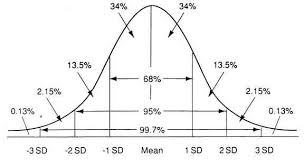
As you can see, the scores are evenly distributed around the mean, with more clustering at the mean and fewer at either end. The percentages show that 68% of the population score within one standard deviation from the mean, 95% score within 2 standard deviations, and 99.7% score within 3 standard deviations.
While this is all fine and dandy, what about the scores that do end up at either end of the curve? What about the extremes? On one hand, you have scores below 55, which is also rare and known as "intellectual disability." This disability can range from mild to profound, with scores ranging from 70 to below 25. These people's abilities also range from reaching 6th grade or 2nd grade levels and contributing to their own support with assistance to requiring constant aid and supervision.
On the other hand, you have the scores above 145, which is rare and known as "gifted". While studying those considered gifted, it is important to keep in mind the differences between a bright student and gifted learner. A bright student may be interested, attentive, learns with ease, good at memorization, etc. while a gifted learner may be highly curious, constructs abstract ideas, good at guessing, keenly observant, etc.
While blogging, I came across an interesting video about raising a gifted child. This specific kid, Nathan, began speaking full sentences at 1 and had a "philosophical breakthrough" at 10. In the video, his mother and him talk about certain difficulties that can arise from being gifted, such as not meeting educational and social needs and being bullied. Eventually, they found a school that suited him and that serves "profoundly gifted children", and there he takes college level, middle school level, and high school level courses, even though he is technically supposed to be in 6th grade.
Another example I thought of was Nolan Gould, who plays Luke Dunphy on the ever-popular show Modern Family. In an interview with Ellen, he discussed his IQ, which is apparently 150. They discuss how he is a part of Mensa, the largest IQ society in the world, and his love for strange instruments. He mentions at one point that his brother is also "advanced," which I thought was interesting, as it could provide evidence for the whole genetics vs. environment deal.
Link to Nathan: http://www.youtube.com/watch?v=UP9Ntay5Oxg
Link to Nolan: http://www.youtube.com/watch?v=bYpHexLNS2I
Basically, when individuals take intelligence tests, aptitude tests, or achievement tests, there needs to be way to score them fairly in regards to everyone else who has taken the same test. In order to do such a thing, people will standardize the test by administering it to a representative sample of future test takers to create a foundation for comparison. Once standardized, the tests will produce a normal distribution of scores, aka a normal curve:
As you can see, the scores are evenly distributed around the mean, with more clustering at the mean and fewer at either end. The percentages show that 68% of the population score within one standard deviation from the mean, 95% score within 2 standard deviations, and 99.7% score within 3 standard deviations.
While this is all fine and dandy, what about the scores that do end up at either end of the curve? What about the extremes? On one hand, you have scores below 55, which is also rare and known as "intellectual disability." This disability can range from mild to profound, with scores ranging from 70 to below 25. These people's abilities also range from reaching 6th grade or 2nd grade levels and contributing to their own support with assistance to requiring constant aid and supervision.
On the other hand, you have the scores above 145, which is rare and known as "gifted". While studying those considered gifted, it is important to keep in mind the differences between a bright student and gifted learner. A bright student may be interested, attentive, learns with ease, good at memorization, etc. while a gifted learner may be highly curious, constructs abstract ideas, good at guessing, keenly observant, etc.
While blogging, I came across an interesting video about raising a gifted child. This specific kid, Nathan, began speaking full sentences at 1 and had a "philosophical breakthrough" at 10. In the video, his mother and him talk about certain difficulties that can arise from being gifted, such as not meeting educational and social needs and being bullied. Eventually, they found a school that suited him and that serves "profoundly gifted children", and there he takes college level, middle school level, and high school level courses, even though he is technically supposed to be in 6th grade.
Another example I thought of was Nolan Gould, who plays Luke Dunphy on the ever-popular show Modern Family. In an interview with Ellen, he discussed his IQ, which is apparently 150. They discuss how he is a part of Mensa, the largest IQ society in the world, and his love for strange instruments. He mentions at one point that his brother is also "advanced," which I thought was interesting, as it could provide evidence for the whole genetics vs. environment deal.
Link to Nathan: http://www.youtube.com/watch?v=UP9Ntay5Oxg
Link to Nolan: http://www.youtube.com/watch?v=bYpHexLNS2I
Subscribe to:
Posts (Atom)